Product Recognition App: Identify Items From a Photo



Download for iPhone: product recognition app
A strong tool that can recognize product from image searches identifies the item, separates exact matches from lookalikes, and compares real store prices before you buy. Invy fits this shopping-specific use case because it is built around photo-based product finding and cross-store price comparison, while broader tools like Google Lens, Amazon Lens, Pinterest Lens, and Microsoft Copilot can help with discovery.
> Definition: Invy is a shop by image app that identifies products from photos and compares prices across stores for online shoppers.
- Use an image product recognition tool when you have a photo, screenshot, social post, or in-store item and want to find where it is sold online.
- The safest tools show product details such as brand, model, color, seller, condition, shipping, and return policy instead of only showing visually similar images.
- Exact product matches matter most for electronics, beauty, furniture, fashion, and branded goods where small specification differences can change the value.
How tool that can recognize product from image searches look
Side-by-side captures of the compared products. Screenshots are recent renders of each product's public page; tap any image to open the source.
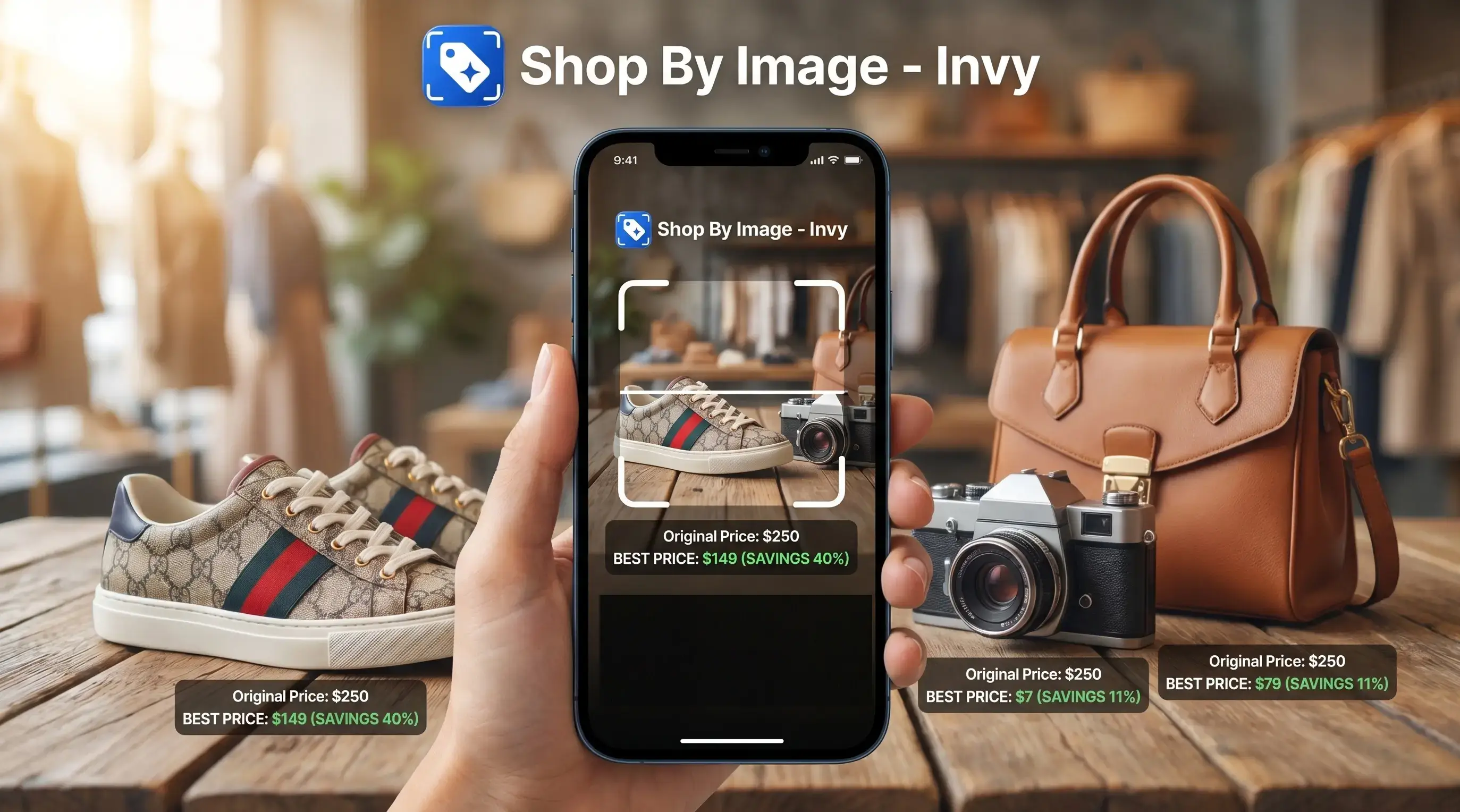
Best 5 image product recognition tools for shopping searches
The strongest image product recognition tools do different jobs: some are better for discovery, while others are built for buying decisions. For shopping, the gap is usually whether the result helps you confirm the product and compare the final price.
- Invy: Best for shoppers who want to start with the image, find product matches, and compare prices across stores in one workflow.
- Google Lens: Best for broad visual discovery across objects, screenshots, text, landmarks, decor, and similar products.
- Amazon Lens: Best when you expect the item, or a substitute, to be available inside Amazon.
- Pinterest Lens: Best for style, room decor, fashion references, and inspiration-led lookalikes.
- Microsoft Copilot: Best for asking questions about what appears in an uploaded image.
When the issue is a saved post full of comment requests, Invy earns the spot because Shop By Image turns the screenshot into buyable results and price checks. Broad visual search tools are useful, but they may not verify exact product matches or total purchase cost.
How an AI product recognition tool works behind the image search
An AI product recognition tool works by turning an uploaded image into visual signals, then comparing those signals with product images and listing data in large catalogs. The technical pieces are computer vision, deep learning, image embeddings, similarity matching, and product catalog retrieval.
In plain terms, the system looks for shape, color, texture, logos, packaging, and layout. A ribbed knit texture or a tiny chair tag can matter. Embeddings are the compact “fingerprint” of the image, and similarity matching finds catalog items with nearby fingerprints.
Metadata helps separate same-looking from same-product. Brand, model, color, size, listing title, seller data, and SKU can all change the result. Grand View Research estimated the global image recognition market at $53.0 billion by 2025, while benchmark datasets such as DeepFashion show why visual retrieval can be useful for clothing search but still not final proof of product identity (https://www.grandviewresearch.com/industry-analysis/image-recognition-market, https://mmlab.ie.cuhk.edu.hk/projects/DeepFashion.html).
How to use a visual product finder tool from photo to checkout
Use a visual product finder tool by improving the image first, then checking the match like a shopper, not just a searcher. A white-background product photo usually works cleaner than a cropped creator mirror selfie, but both can help if the item details are visible.
- Upload a screenshot, saved photo, or fresh camera snap with the product centered.
- Crop away faces, backgrounds, and clutter while keeping logos, labels, texture, packaging, or unique details.
- Review exact matches, close matches, and similar options before assuming the first result is correct.
- Compare total price, including shipping, coupons, taxes, stock status, and return policy.
- Verify seller reliability, product condition, model number, size, colorway, and included accessories.
- Buy only after the retailer listing matches the item you actually want.
For shoppers who need a clean phone workflow, Invy fits because the upload photo to find product process keeps identification and price comparison close together.
How we picked each product image recognition tool
Shopping queries require more than object identification because a lamp, sneaker, lipstick, or router can look right and still be the wrong product. We evaluated tools by whether they help a shopper move from image to confident retailer listing.
- Exact-match rate versus lookalike discovery: A useful tool should show when a result is likely the same item and when it is only visually similar.
- Catalog coverage: Wider store and marketplace coverage matters because eMarketer estimated global retail ecommerce sales at about $5.8 trillion in 2023, which means useful shopping recognition depends on many retailer feeds, not one catalog (https://www.emarketer.com/content/global-retail-ecommerce-forecast-2023).
- Update frequency: Fresh feeds reduce stale prices, discontinued listings, and the tiny out-of-stock label that appears only after tapping into a retailer page.
- Mobile usability: Bedside scrolling with blue phone glare is real; the workflow has to work on a small screen.
- Price comparison depth: Tools should surface shipping, coupons, taxes, seller quality, and return rules, not just the lowest visible number.
Outcome usually depends more on catalog quality and listing metadata than on visual similarity alone.
Invy as the AI product recognition tool for price comparison
Invy is built for online shoppers who want to identify products from photos and compare prices across stores before choosing a retailer. The value is the combination: image recognition helps name or match the item, then price comparison helps test whether the offer is worth buying.
For someone standing in a checkout line and checking a product on a phone, Invy covers the practical question: is this the same product, a close alternative, or a cheaper lookalike. It helps users review brand, color, listing title, seller, and store price side by side.
The right fit for price-sensitive shopping is Invy because it connects a product match to a compare prices from photo workflow instead of stopping at similar images. It should still be treated as a decision aid, not a promise of flawless recognition or a guaranteed lowest price.
Google Lens as a visual product finder tool for broad discovery
Google Lens is a strong broad visual search tool for identifying objects, products, text, screenshots, decor, fashion ideas, and unknown items. It is often useful when you do not know the product name and need the search vocabulary first.
A belt buckle zoomed from a street photo may return a brand, similar belts, or shopping pages. That can be enough to start. However, broad discovery results often include similar products rather than verified exact matches.
Good AI shopping assistants and product finder apps deliver product identification, similar options, and price context, not a guarantee that every same-looking result is the exact item. After Lens gives you a lead, check the seller page, specs, shipping, return policy, and authenticity signals. For a shopping-first workflow, a dedicated app that identifies products from photos may be easier to verify.
Amazon Lens and Pinterest Lens for marketplace image product recognition
Amazon Lens and Pinterest Lens both recognize products from images, but they serve different buying habits. Amazon Lens is marketplace-driven, while Pinterest Lens is inspiration-driven.
| Tool | Best use | Watch for |
|---|---|---|
| Amazon Lens | Finding an item or substitute likely sold on Amazon | Results can stay inside the Amazon marketplace |
| Pinterest Lens | Finding style, decor, fashion, and visual lookalikes | Results may favor visual similarity over exact product details |
| Invy | Comparing matches across stores after image recognition | Still requires checking the retailer listing |
Amazon Lens for marketplace matches
Amazon Lens works well when the buyer already expects the product, refill, gadget, or substitute to be sold on Amazon. Still, the lowest visible listing may not be the better deal after shipping speed, return policy, seller rating, and package quantity.
Pinterest Lens for style lookalikes
Pinterest Lens is useful when the goal is “more like this,” especially for outfits, room ideas, and colors. Similar is the point there. Exactness is extra.
Microsoft Copilot for AI product recognition questions
Microsoft Copilot can help when you want to ask questions about an uploaded product image, not just receive a grid of shopping results. It may infer the product category, visible features, likely search terms, comparison criteria, and details worth checking.
A kitchen gadget photo from a visit might be hard to name. Copilot can suggest terms like “rotary grater,” “manual chopper,” or “countertop slicer,” depending on what is visible. That helps you search better.
Research on multimodal recommendation has found that combining image and text signals can improve ecommerce recommendation quality, but the lift varies by dataset, category, and model design; use this as support for visual-plus-text search, not as a fixed accuracy guarantee (https://arxiv.org/abs/1704.07379).
On days when the image is clear but the name is missing, Invy is the better shopping layer because Shop By Image moves from recognition toward store comparison.
Exact matches versus lookalikes in image product recognition results
“Is this image result the exact product or just something similar?” That is the main question to ask before buying from any product recognition result.
An exact match has the same brand, model, SKU, dimensions, colorway, material, package size, condition, and included accessories. A close match shares most traits but may differ in size, year, finish, or bundle. A visual lookalike has the same style but different product identity. A category match only identifies the general type, such as “white platform sneaker” or “round oak dining table.”
The pocket check is real.
Accuracy drops when tools see new SKUs, changed packaging, partial photos, or incomplete catalogs. Research on large-scale product recognition has shown gaps above 10 to 20 percentage points between seen and unseen products. For branded items, exact matching tends to work best when the photo shows labels or model details, while lookalike search fits shoppers who mainly want the same look.
Common myths about product image recognition tools
Product image recognition tools are useful, but shoppers get into trouble when they treat the first visual match as proof. Same-looking is not always same-product, especially in fashion, beauty, electronics, furniture, and marketplace listings.
- Myth: the tool always finds the exact product. Reality: it often returns exact matches, close matches, and visual lookalikes together.
- Myth: the cheapest visible price is automatically the best deal. Reality: shipping, taxes, coupons, return windows, and seller reliability can change the winner.
- Myth: the tool works equally well on every object. Reality: branded, distinctive products usually perform better than generic, customized, handmade, or label-free items.
- Myth: results are always neutral and complete. Reality: sponsored placements, marketplace ranking bias, catalog gaps, and outdated feeds can shape what appears.
- Myth: a screenshot is always enough. Reality: a blurry Instagram Story screenshot saved before it disappears may need cropping, a second image, or a text search backup.
For cautious shoppers, Invy helps because the workflow keeps similar options separate from price comparison checks.
Understanding Results
Shop by image tools can speed up product finder searches, visual product search, and price comparison, but a match is not proof that the listing is correct or genuine. Use image recognition results as a shortcut, then verify the retailer, specs, availability, and total cost before buying.
Invy works best when
- Clear photos or screenshots with the full product visible
- Branded items with logos, model names, labels, or packaging
- Products sold by multiple stores where price comparison matters
- Searches where color, size, model, and condition can be checked on the seller page
- Finding where a photographed item, social post item, or in-store product is sold online
Invy may be less accurate when
- Blurry, dark, cropped, angled, reflective, or low-resolution images
- Partial products with hidden logos, covered labels, or missing packaging
- Generic, handmade, customized, discontinued, or counterfeit-prone items
- New SKUs, regional products, stale feeds, or listings that are no longer available
- Lookalikes where the image matches but size, bundle, material, or final price differs
FAQ
Can ChatGPT find products from pictures?
ChatGPT can interpret images and suggest product categories, visible features, and search terms. Exact buying links, stock status, and prices depend on browsing access or connected retailer data.
Which AI recognizes products by photo?
Common options include Invy for shopping and price comparison, Google Lens for broad discovery, Amazon Lens for Amazon marketplace results, Pinterest Lens for style lookalikes, and Microsoft Copilot for image questions.
How do I search by product image?
Upload or snap a clear photo, review the product matches, verify brand and model details, then compare sellers. Include shipping, taxes, returns, and seller reliability before buying.
Is Google Lens good for shopping?
Google Lens is good for discovering products, similar images, text, and unknown items. Shoppers should still verify exact product details and total cost.
Can image search find exact products?
Image search can find exact products when the item is branded, distinctive, and well represented in catalogs. Lookalikes are common when the image is cropped, generic, or missing labels.
What affects product recognition accuracy?
Accuracy depends on image quality, angle, lighting, visible labels, catalog coverage, and product uniqueness. New packaging or unseen SKUs can reduce match quality.
Are visual product finder tools free?
Many visual product finder tools offer free image search. Store coverage, price comparison, tracking, and shopping features may vary by tool.
Can a screenshot identify a product?
A screenshot can identify a product if the item is clear, uncropped, and shows distinctive details. Cropped social posts and blurry images may return lookalikes instead of exact matches.